Hyperpigmentation & Melasma
Hyperpigmentation & Melasma Treatment in Agoura Hills
Brown spots, uneven skin tone and patches of discoloration can make your skin look less clear and even—even when you are doing everything right with your skincare.
But not all pigmentation is the same.
Sun damage, post-inflammatory hyperpigmentation and melasma can look similar, but they may respond very differently to treatment. In fact, treating pigmentation too aggressively can sometimes make it worse, particularly in patients who are prone to melasma or post-inflammatory hyperpigmentation.
At AIVI Aesthetics in Agoura Hills, we take a thoughtful, skin-first approach.
We evaluate the pattern of your pigmentation, your skin type, potential triggers, treatment history and goals before recommending a plan.
Our goal is not simply to lighten a spot.
It is to help you achieve healthier, brighter and more even-looking skin while minimizing unnecessary irritation and inflammation.
Hyperpigmentation
What Is Hyperpigmentation?
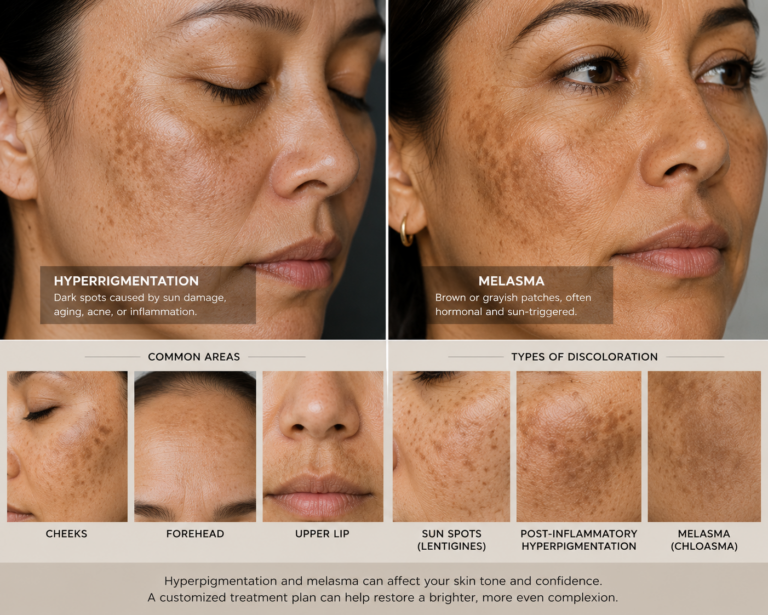
Hyperpigmentation is a broad term used to describe areas of skin that appear darker than the surrounding skin because of increased pigment.
It can appear as:
- Brown spots
- Uneven skin tone
- Dark patches
- Post-acne marks
- Sun spots
- Areas of discoloration after inflammation or injury
Several different conditions can cause hyperpigmentation, which is why identifying the likely cause matters before choosing a cosmetic treatment.
What Causes Hyperpigmentation?
Pigmentation can be influenced by several factors, including:
- UV exposure
- Hormonal changes
- Acne
- Skin inflammation
- Previous skin injuries
- Certain medications
- Genetics
- Heat and visible light
- Irritating skincare products or procedures
In Southern California, ongoing sun exposure can make pigmentation especially difficult to control without consistent sun protection.
What Is Melasma?
Melasma is a chronic pigmentation condition that typically appears as symmetrical brown or gray-brown patches, commonly involving the:
- Cheeks
- Forehead
- Upper lip
- Nose
- Chin
Unlike an isolated sun spot, melasma can be influenced by multiple triggers.
These may include sun exposure, visible light, heat, hormonal changes and genetics.
This is why melasma should not automatically be treated like ordinary sun damage.
Hyperpigmentation vs. Melasma: What's the Difference?
Although they can look similar, hyperpigmentation and melasma are not necessarily the same condition.
| Hyperpigmentation | Melasma | |
|---|---|---|
| Appearance | Individual spots or uneven areas | Often symmetrical patches |
| Common triggers | Sun, acne, inflammation, injury | Sun, hormones, heat, visible light, genetics |
| Can recur? | Depends on cause | Frequently |
| Treatment approach | Depends on pigmentation type | Usually requires ongoing management |
| Aggressive treatment | Sometimes appropriate | Requires greater caution |
One of the most important parts of treating pigmentation is understanding what we are actually treating.
Hyperpigmentation Concerns Treatments
-
Medical-Grade Skincare for Hyperpigmentation
Skincare is often one of the most important parts of a pigmentation treatment plan. Depending on your skin, a regimen may focus on: Reducing excess pigment production Supporting skin turnover Improving overall skin tone Strengthening the skin barrier Reducing inflammation Protecting against additional UV exposure A complicated routine is not necessarily a better routine. We prefer a targeted plan that your skin can tolerate consistently.
-
Chemical Peels for Hyperpigmentation
Chemical peels may help improve certain types of superficial pigmentation by encouraging controlled exfoliation and skin renewal. Depending on the patient, a peel may help with: Sun-induced discoloration Post-acne marks Dullness Uneven tone Superficial pigmentation Rough texture At AIVI Aesthetics, VI Peel may be considered for appropriate patients. However, stronger is not automatically better—particularly when melasma is present. Learn More About VI Peel
-
Microneedling for Pigmentation and Uneven Skin Tone
Microneedling creates controlled microchannels that stimulate the skin's natural repair process. It may be useful when pigmentation is accompanied by: Uneven texture Acne scarring Enlarged-looking pores Fine lines Dull skin For patients with pigment-prone skin, treatment technique and aftercare are particularly important because inflammation itself can contribute to additional pigmentation. Learn More About Microneedling
-
CO2 Laser Treat Hyperpigmentation?
Laser resurfacing can be an excellent treatment for certain signs of photoaging, but pigmentation requires careful patient selection. At AIVI Aesthetics, CO2 resurfacing may be considered when discoloration occurs alongside concerns such as: Sun damage Fine lines Rough texture Enlarged-looking pores Acne scars Overall photoaging However, CO2 laser is not automatically the right treatment for melasma. Heat and inflammation can potentially trigger or worsen melasma and post-inflammatory hyperpigmentation in susceptible patients. This is why we evaluate your skin before recommending laser treatment rather than treating every brown spot the same way. Learn More About CO2 Laser Resurfacing & CoolPeel®
-
RF Microneedling Help Pigmentation
RF microneedling is generally used more for collagen remodeling, texture, pores, acne scars and skin laxity than for isolated pigmentation. However, it may be considered when someone has multiple concerns at the same time. For example, a patient may have: Sun damage + uneven texture + enlarged pores + early skin laxity. Instead of treating only the discoloration, we may create a plan that addresses overall skin quality.
Why Does My Pigmentation Keep Coming Back?
This is especially common with melasma.
Melasma is better thought of as a condition that needs to be managed over time, rather than something that can always be permanently removed with one procedure.
Even after improvement, pigmentation may return after:
- Significant sun exposure
- Heat exposure
- Hormonal changes
- Pregnancy
- Inconsistent sunscreen use
- Skin inflammation
- Irritating treatments
That is why maintenance and prevention are just as important as the treatment itself.
How Do We Treat Hyperpigmentation at AIVI Aesthetics?
There is no single treatment that is appropriate for every type of pigmentation.
Your plan may include a combination of:
- Professional skincare
- Daily sun protection
- Pigment-correcting products
- Chemical peels
- Microneedling
- Carefully selected resurfacing treatments
- Treatments focused on overall skin health
The treatment we choose depends on your skin type, the suspected cause of the pigmentation and how reactive your skin is.
What About Melasma?
Melasma deserves its own treatment strategy.
Our approach is generally more conservative because the goal is to improve pigmentation without creating unnecessary inflammation that could make the condition worse.
Treatment may include:
1. Control the triggers
Daily sun protection is essential.
Heat and visible light may also contribute to melasma in some patients.
2. Establish appropriate skincare
A consistent pigment-control regimen may be recommended before more aggressive procedures are considered.
3. Reduce unnecessary inflammation
More treatment is not always better.
Repeated aggressive resurfacing can be counterproductive in melasma-prone skin.
4. Introduce procedures selectively
Chemical peels, microneedling or other treatments may be considered depending on the patient’s skin and pigmentation pattern.
5. Maintain the result
Melasma frequently requires ongoing maintenance.
Our goal is long-term control rather than promising a permanent cure.
Can You Completely Get Rid of Melasma?
Melasma can often be improved significantly, but it has a tendency to recur.
For that reason, we do not promise that a single treatment will permanently eliminate melasma.
A better goal is:
Improve the pigmentation → identify triggers → protect the skin → maintain the improvement.
That approach is more realistic and often more successful long term.
Sun Spots vs. Melasma
Sun spots tend to appear as more defined areas of pigmentation related to cumulative UV exposure.
Melasma often appears as broader, symmetrical patches and can be influenced by hormones, sun, heat and other factors.
The distinction matters because a procedure that works beautifully on isolated sun damage may not be the best choice for melasma.
If your primary concern is photoaging rather than melasma:
Hyperpigmentation After Acne
Sometimes the dark marks left after acne are mistaken for acne scars.
They are not necessarily the same problem.
Post-inflammatory hyperpigmentation (PIH) is discoloration that develops after inflammation.
An acne scar involves a change in the structure or texture of the skin.
You can also have both.
If your primary concern is indentation or uneven texture, your treatment may need to focus more on scar remodeling.
Frequently Ask Questions
There is no single best treatment because hyperpigmentation has multiple causes. Professional skincare, chemical peels, microneedling and selected resurfacing treatments may all be appropriate depending on the type of pigmentation and your skin.
Melasma usually requires a combination approach focused on sun protection, pigment-control skincare, trigger management and carefully selected procedures when appropriate.
Chemical peels may improve certain types of superficial pigmentation, but the results depend on the cause and depth of the discoloration.
Microneedling may be considered for selected patients, particularly when pigmentation occurs alongside texture changes or acne scarring. Patients prone to PIH require careful treatment planning.
CoolPeel may be useful when sun-related discoloration occurs with texture, fine lines and other signs of photoaging. It is not automatically appropriate for every pigmentation disorder, particularly melasma.
Heat and inflammation can trigger melasma in some individuals, so laser treatment requires careful patient selection. Melasma should not automatically be treated like ordinary sun damage.
Skin inflammation can sometimes trigger post-inflammatory hyperpigmentation, particularly in pigment-prone skin. This is one reason treatment intensity, preparation, aftercare and sun protection matter.
Melasma commonly recurs because it is influenced by ongoing triggers such as UV exposure, visible light, heat and hormonal factors. Long-term maintenance is often necessary.
That depends on the cause of the pigmentation and treatment selected. Some patients may need a series of procedures combined with ongoing home skincare rather than one treatment.
EXCELLENT Based on 68 reviews
 Posted on Google
 Dimitra PapaspyridiI came to AIVI Aesthetics for Sculptra and a CoolPeel CO₂ laser treatment, and honestly, I couldn’t be happier with my results. What sets this place apart is Angelica’s level of expertise. She’s highly trained in advanced injectables and has such a thoughtful approach. She didn’t just treat one area; she looked at my whole face and created a plan that made everything look natural and balanced. I just look refreshed and glowing. I love that Angelica explains everything and really listens to what you want. I’m already booked for round 2 and cannot wait. If you’re considering investing in your skin, this is the place. You’re in the best hands. 🙌✨Posted on Google
 Brenda GarciaI recently got a Cool Peel treatment and I'm honestly blown away by the results. The whole experience was smooth from start to finish. Angelica was knowledgeable, explained everything clearly, and made me feel completely at ease. The treatment itself was surprisingly comfortable, much gentler than I expected. I would absolutely recommend Cool Peel to anyone looking to improve their skin texture and radiance without a long downtime. I'm already looking forward to my next session! TPosted on Google
 Diane BlindburyAngelica was so professional and informative on educating me on my options and recommendations. I will definitely be continuing to trust her and use her services.Posted on Google
 Jaime SandovalAbsolutely thrilled with my experience at Aivi! As a man who was initially self-conscious about seeking aesthetic procedures like Botox, I was a bit apprehensive before my first appointment. However, from the moment I walked in, I felt welcomed and at ease. Angelica Chang took the time to listen to all my concerns and answered every question I had, which really helped alleviate my anxiety. Her professionalism and warm demeanor made a world of difference. She explained the entire process clearly and made sure I was comfortable throughout. The results have exceeded my expectations! I couldn’t be happier with how natural everything looks. I genuinely feel more confident and refreshed. If you’re considering Botox, especially as a man, I highly recommend seeing her. You’ll be in great hands! Thank you for such a wonderful experience!Posted on Google
 Anita NeumannI had the CO2 Tetra Pro laser treatment done ten days ago. The results are phenomenal! The treatment itself was intense but not at all painful. The downtime was minimal! I actually attended a Gala event four days into my recovery!! I highly recommend this procedure. You will be amazed by the results. Thank you Angelica! I will see you soon for more treatments.Posted on Google
 Christine CalafatiI received the CO2 Deka Laser treatment 8 days ago and my skin has been transformed. Old deep acne scars, crept textured skin and fine lines have essentially been smoothed and almost non existent now. Highly recommend this procedure for anyone that wants a complete overhaul on their facePosted on Google
 Joseph SchultzVery happy with results! Angelica and Rio were incredibly helpful, put me at ease with the procedure (1st time!), very knowledgeable and answered all my questions I had. Can’t wait to come back.Posted on Google
 Gwyn SwigAngelica makes sure you are comfortable and takes her time to help you understand what you want.Verified by TrustindexTrustindex verified badge is the Universal Symbol of Trust. Only the greatest companies can get the verified badge who has a review score above 4.5, based on customer reviews over the past 12 months. Read more
Hyperpigmentation & Melasma Treatment Near Westlake Village, Calabasas and Thousand Oaks
If uneven pigmentation, dark spots or melasma are making your skin look less clear and even, we’re here to help.
Schedule your personalized consultation at AIVI Aesthetics to determine what type of pigmentation you may be dealing with and which treatment approach is appropriate for your skin. Depending on your concerns, your plan may include VI Peel, professional skincare, microneedling or carefully selected CO2 laser resurfacing and CoolPeel®.
Call us directly at (818) 851-9900 or contact us. We’ll evaluate your skin, answer your questions and develop a customized treatment plan based on your pigmentation pattern, skin type and goals.
We proudly welcome patients from Agoura Hills, Westlake Village, Thousand Oaks, Calabasas, Oak Park, Newbury Park, Camarillo, Malibu, and communities throughout the Conejo Valley seeking personalized, medically guided treatment for hyperpigmentation, melasma and uneven skin tone.